

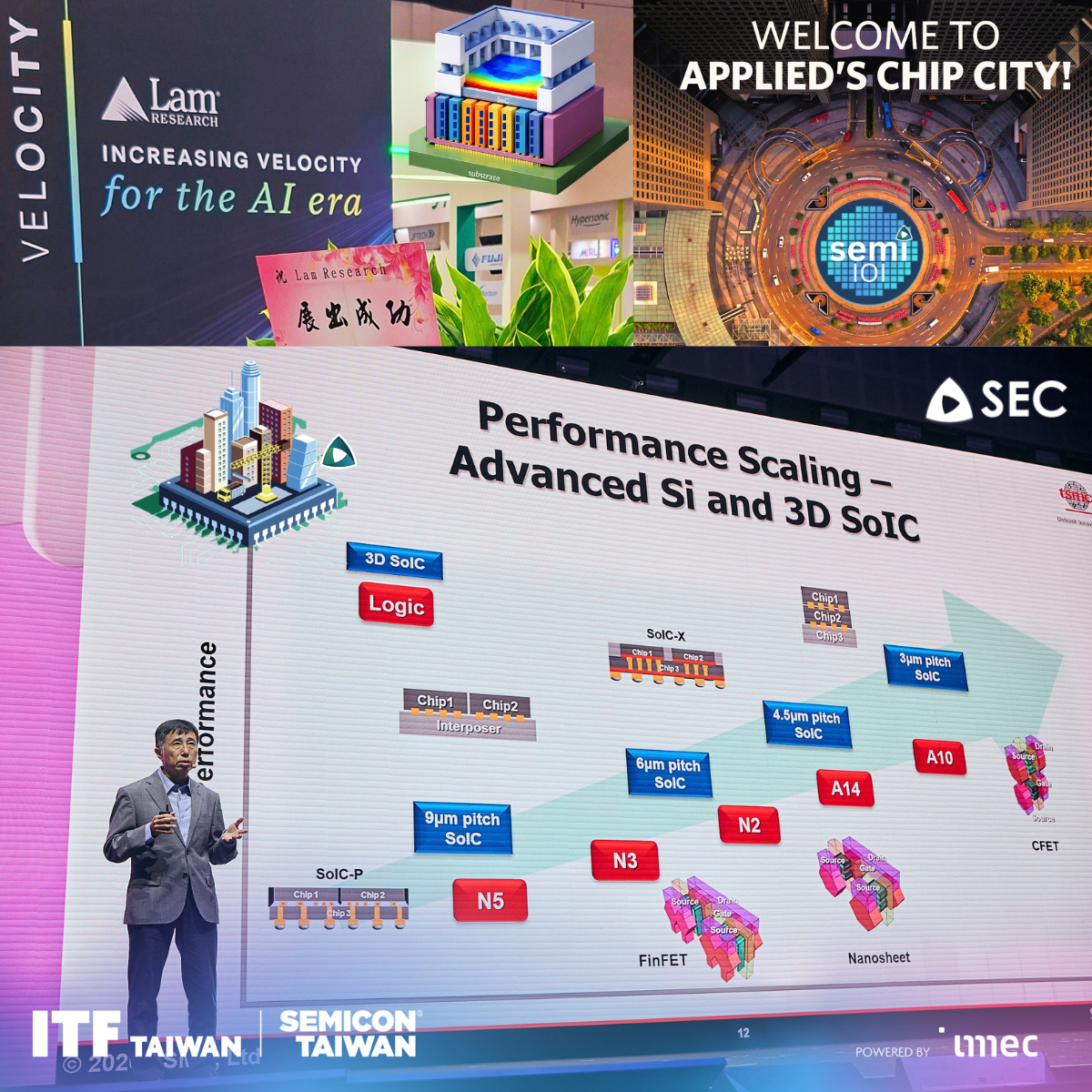
At SEMICON Taiwan 2026, TSMC highlighted the evolution of AI system integration across CoWoS, SoIC, HBM, CPO, power delivery, and thermal management.
Future CoWoS platforms are evolving beyond advanced packaging into an integrated: Compute × Memory × Power × Thermal × Optical AI system fabric.
At ITF Taiwan 2026, Patrick Vandenameele (imec) set the stage on technology and system challenges for scalable AI, K.C. Hsu (TSMC) and Mark Kiehlbauch (Micron) showed what heterogeneous integration and memory technology need to deliver.
AI is the driver but the compute engine must follow, AI progress: Algorithms x Scaling x Fabric x Architectures
The 3 bottlenecks are clear but different. Manufacturing, infrastructure, process expertise, market knowledge and the right industry connections start to matter just as much as the underlying technology:
→ Chipmakers: racing to outpace demand with pure silicon VeloCity
→ Data centre developers: racing to secure land and high-voltage grid power or Smart Grid
→ Generative AI software: racing to convert compute into cold hard revenue before the runway ends
AI is compressing chip development timelines. Lam Research ’s VeloCity means speed plus direction, a deliberate transformation of how Lam innovates, manufactures, and supports customers using AI and virtual twin modeling powered by Semiverse solutions. They help customers enable advanced packaging and interconnect technologies for next-generation devices and sub-components deliver precision process technologies that help customers meet increasingly demanding manufacturing requirements. In Applied Material’s semiconductor ChipCity, imagine multilayer metal highways connecting every part of a chip. Interconnects route signals across and between layers of metal at lightning speed like a city highway. Chiplets are stacked like silicon high-rises, connected by hybrid bonding to build the city skyline!
Taiwan’s edge isn’t really about cheap inputs. It’s a decades-deep ecosystem of suppliers, technicians, and OSATs that lets fabs ramp up faster and run leaner. Roughly $1 trillion is set to pour into chip manufacturing through 2030 to produce more than $1 trillion chips. Taiwan owns the Package, US owns the Tools and Europe still owns the light and photonics.

